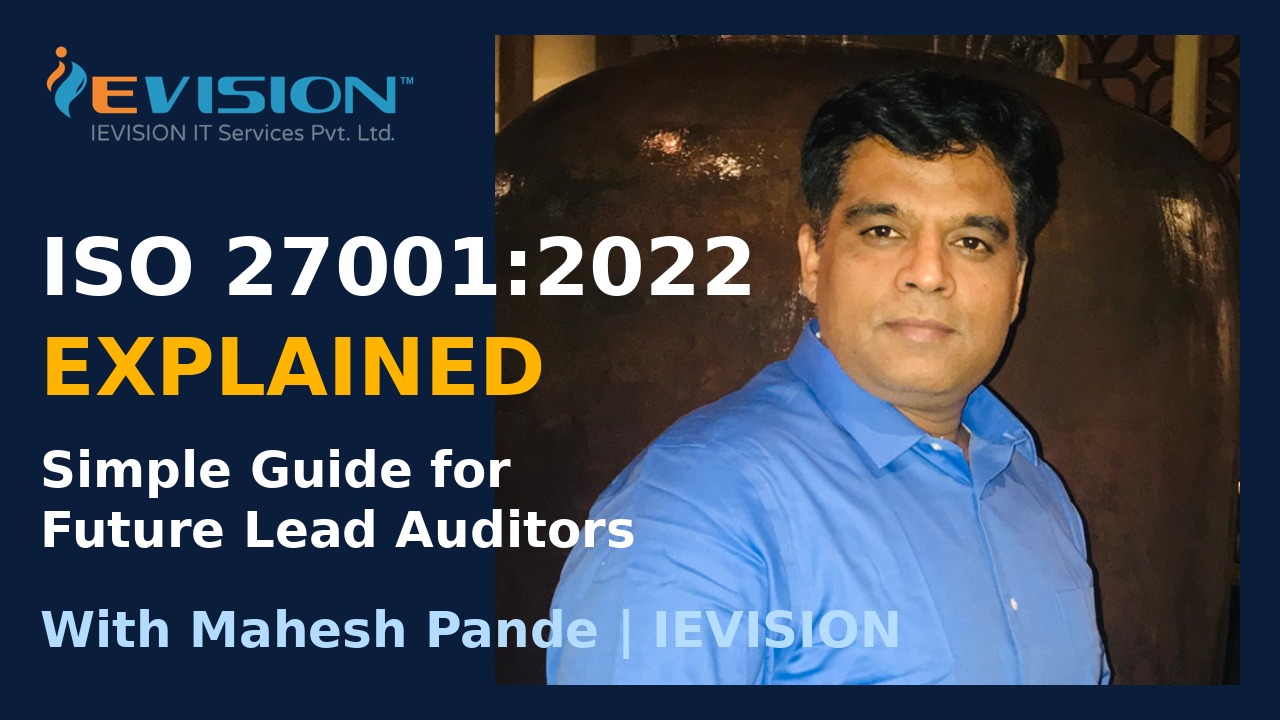
ISO 27001:2022 Explained – A Simple Guide for Future Lead Auditors
By Mahesh Pande | IEVISION IT Services
In today’s digital environment, information security, data privacy and cyber security is not optional, it’s essential.
Organizations worldwide rely on ISO/IEC 27001:2022 Information Security Management System standard to protect sensitive data, manage cyber risks, and demonstrate compliance. For professionals preparing to become ISO 27001 Lead Auditors or Implementers, understanding the ISMS framework, Clause 4–10 structure, and Annex A controls (93) is critical.
This guide is aligned with the training approach used in the ISO 27001 Lead Auditor and Implementer Course by Mahesh Pande at IEVISION IT Services—breaks down the standard in a simple, auditor-friendly format.
Understanding ISO 27001:2022 and the ISMS Framework
ISO/IEC 27001:2022 Information Security Management System standard defines how organizations build an Information Security Management System (ISMS).
An ISMS framework is a systematic approach to:
• Protect confidentiality, integrity, and availability of information
• Manage cybersecurity risks
• Establish security policies and controls
• Continuously improve information security practices
ISO 27001:2022 follows the Plan–Do–Check–Act (PDCA) cycle, ensuring continuous improvement. Join ISO 27001 Lead Auditor certification course
PDCA Cycle in ISO 27001
The Plan Do Check Act Cycle is the backbone of the ISMS framework.
PLAN: Define the ISMS scope, policies, objectives, and risk assessment methodology.
DO: Implement security controls and operational processes.
CHECK: Monitor, measure, and conduct internal audits.
ACT: Improve the ISMS based on audit results and management review.
For Lead Auditors, understanding how each clause fits into the PDCA cycle is essential during audits.
Clause-by-Clause Breakdown (ISO 27001:2022 Clauses 4–10)
Clause 4 – Context of the Organization: This clause requires organizations to understand:
• Internal and external issues affecting security
• Stakeholder requirements
• Scope of the ISMS
Lead auditors verify:
• Documented scope
• Identification of interested parties
• Alignment between scope and risk assessment
Typical audit question:
“How did the organization determine its ISMS scope?”
Clause 5 – Leadership commitment is crucial for a successful ISMS.
Requirements include:
• Information security policy
• Defined roles and responsibilities
• Top management support
Auditors to evaluate:
• Whether leadership actively supports security initiatives
• Availability of an approved security policy
• Assigned responsibilities such as ISMS manager
Clause 6 – Planning: Focuses on risk management.
Organizations must:
• Identify information security risks
• Perform risk assessment and risk treatment
• Define security objectives
Auditors to check:
• Risk assessment methodology
• Risk register
• Risk treatment plan
• Statement of Applicability (SoA)
This clause is often a major focus area during ISO 27001 certification audits.
Clause 7 – Support This clause ensures the organization has adequate resources, competence, awareness, and documentation.
Key elements include:
• Employee competence
• Training programs
• Documented information
• Communication processes
Auditors to verify:
• Training records
• Awareness programs
• Document control procedures
Clause 8 – Operation ensures the implementation of the risk treatment plan and security controls.
Organizations must:
• Execute operational security processes
• Manage changes securely
• Control outsourced processes
Auditors to evaluate:
• Whether security controls are actually implemented
• Evidence of operational procedures
• Vendor and third-party risk management
Clause 9 – Performance Evaluation ensures that the ISMS is monitored and evaluated.
Key activities:
• Internal audits
• Management review
• Performance monitoring
Lead auditors to review:
• Internal audit program
• Audit reports
• Management review minutes
Clause 10 – Improvement focuses on continuous improvement.
Organizations must:
• Manage nonconformities
• Implement corrective actions
• Improve the ISMS
Auditors to check:
• Corrective action records
• Root cause analysis
• Evidence of ISMS improvement
Join ISO 27001 Lead Auditor certification course
Annex A Controls – Overview of the 93 Security Controls
The ISO 27001:2022 Annex A Controls contain 93 security controls grouped into four themes. All 93 Controls are directly derived from ISO 27002:2022 Standard clause 5-8.
1. Organizational Controls (37 Controls): Focus on governance and security policies.
• Information security policy
• Supplier relationships
• Incident management
2. People Controls (8 Controls): Focus on employee security responsibilities.
• Background verification
• Security awareness training
3. Physical Controls (14 Controls): Protect physical assets.
• Secure areas
• Equipment protection
4. Technological Controls (34 Controls): Focus on cybersecurity and IT systems.
• Access control
• Cryptography
• Network security
• Logging and monitoring
Guidance to Auditors: Lead auditors always verify whether:
• Selected controls match the risk assessment
• Controls are documented in the Statement of Applicability (SoA)
Why ISO 27001 Knowledge Is Critical for Future Lead Auditors
Professionals trained through IEVISION IT Services ISO 27001 Lead Auditor and Implementer programs gain practical expertise in:
• ISMS implementation
• Risk assessment techniques
• Audit planning and execution
• Annex A control verification
• Certification audit readiness
Under the mentorship of Mahesh Pande Sir, participants learn real-world auditing practices used in certification audits.
Understanding ISO/IEC 27001:2022 Information Security Management System standard is essential for professionals working in information security, compliance, and auditing.
Future ISO 27001 Lead Auditors must master:
• Clause 4–10 requirements
• Annex A’s 93 security controls
• The ISMS framework
• The PDCA continuous improvement model
With proper training and practical exposure—such as the programs offered by IEVISION IT Services—professionals can confidently conduct ISO 27001 audits and help organizations strengthen their cybersecurity posture.
Join ISO 27001 Lead Auditor certification course
+919604647000 +919604664000 +919604641000 info@ievision.org centermanager@ievision.org www.ievision.org
Delivering Training, Consulting and Professional
Certification Since 2012